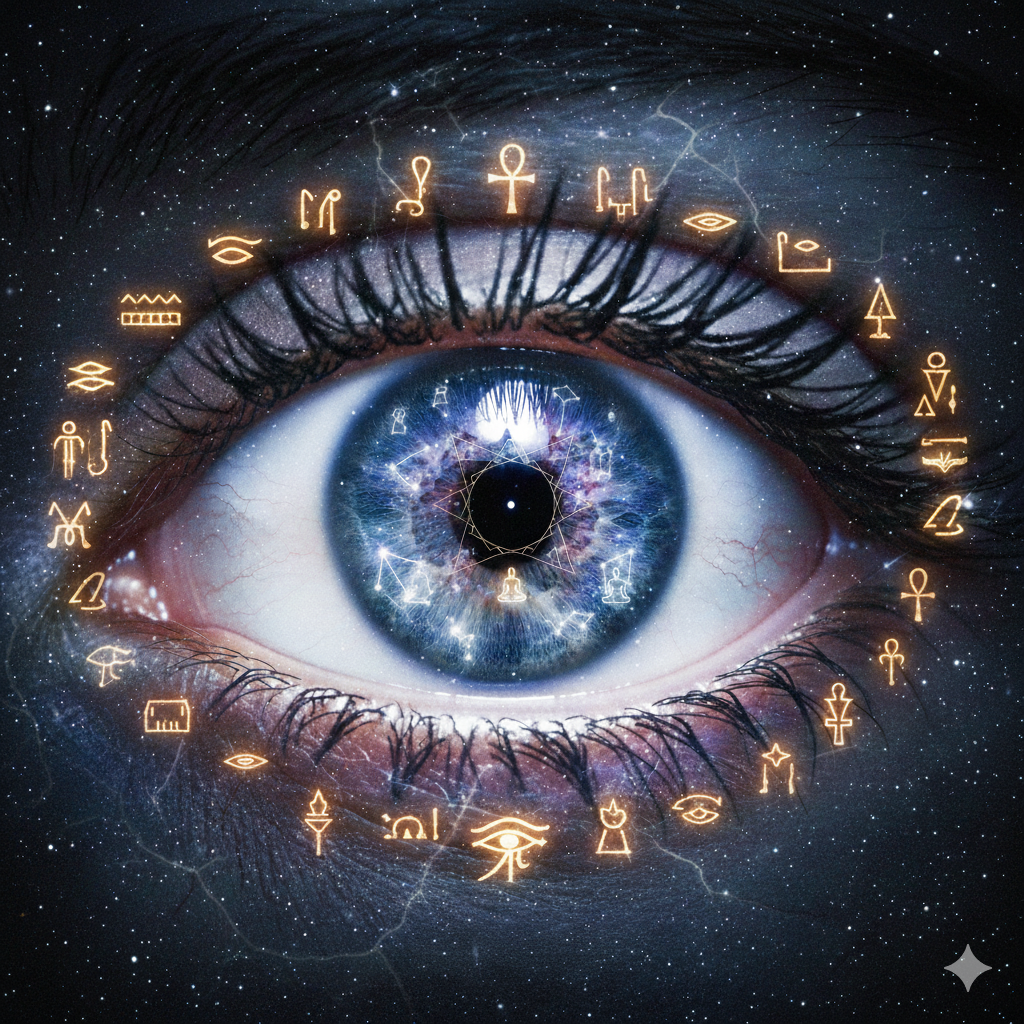
The eye is one of the most complex and ancient organs of our evolution. It captures light, reveals forms, modulates depth, and shapes our relationship to the world. Yet in every culture, it has also represented inner presence, consciousness, and vigilance. Ancient Egypt crystallized this vision in the Wedjat, the “intact” or “restored” eye. The term, from the Egyptian wḏȝ, does not refer to an ordinary eye, but to the eye of Horus after its healing. In the myth, Seth tears out or breaks the falcon god’s eye during their struggle for kingship, and Thoth, master of knowledge, restores it. This act makes the Wedjat a symbol of regained wholeness, protection, and clarity.
Scribes associated this symbol with a particular system of fractions detailed in the Rhind Mathematical Papyrus. Each stylized part of the Wedjat corresponds to a fraction: the eyebrow to 1/2, the pupil to 1/4, the white of the eye to 1/8, the iris to 1/16, the lower curve to 1/32, and the tear to 1/64. The total reaches 63/64, leaving a missing portion. This absent fragment was attributed to the immaterial dimension of knowledge — that which ordinary sight cannot grasp. The artisans of Deir el-Medina used these symbols in their calculations, engraved on ostraca — shards of stone or pottery used for daily notation — showing that this language was not merely mystical but integrated into practical life.
Modern science reveals yet another dimension of seeing. The pupil reacts not only to light but also to emotions, memory, desire, and surprise. It dilates with intense attention and contracts with tense vigilance. The iris, with its unique patterns, reflects biological constitution, vitality, and predispositions; iridology explores it as a mirror of the individual’s overall state. Thus the eye is not simply a passive receiver: it records, translates, and expresses the inner condition.
At the center of the brain, the pineal gland introduces a dimension intimately linked to the symbolism of sight. This small, light-sensitive structure, which regulates biological rhythms, has long intrigued spiritual traditions that view it as a center of inner vision. It produces melatonin, activates in darkness, and has a shape reminiscent of a simplified eye or an inward-pointing cone of light. Its traditional association with a “third eye” reflects the belief that knowledge does not arise solely from the senses, but from a subtler field of consciousness.
Accounts of near-death experiences broaden the inquiry even further. Witnesses describe clear vision even while the body is inactive or clinically dead. They see scenes, observe their surroundings, move outside their body without the physical eyes being able to function. What kind of sight perceives these images? What form of vision allows this experience when the biological organ is offline? This question echoes the missing fraction of the Wedjat: a part of vision that does not depend on matter — a capacity for perception not conditioned by the physical eye.
These accounts challenge the very nature of consciousness. Is vision produced by the eye, or merely revealed through it? Does a residual perception exist when the organ ceases to function? And if consciousness can see without the retina, what is this gaze that remains?
The inner eye, the restored eye, the eye that never blinks, may represent precisely this faculty evoked by traditions across millennia.
Meditation offers a field for direct experience. By calming sensory influx, it allows a different perception of light, mental forms, and the subtle movements of attention. Vision turns inward, perception deepens, and one discovers that the eye is no longer limited to the anatomical organ but becomes a function of presence. In silence and concentration, something opens and observes effortlessly — as though a part of the Wedjat were returning to its place, a gaze that needs no eyelids, an inner eye that truly never blinks.