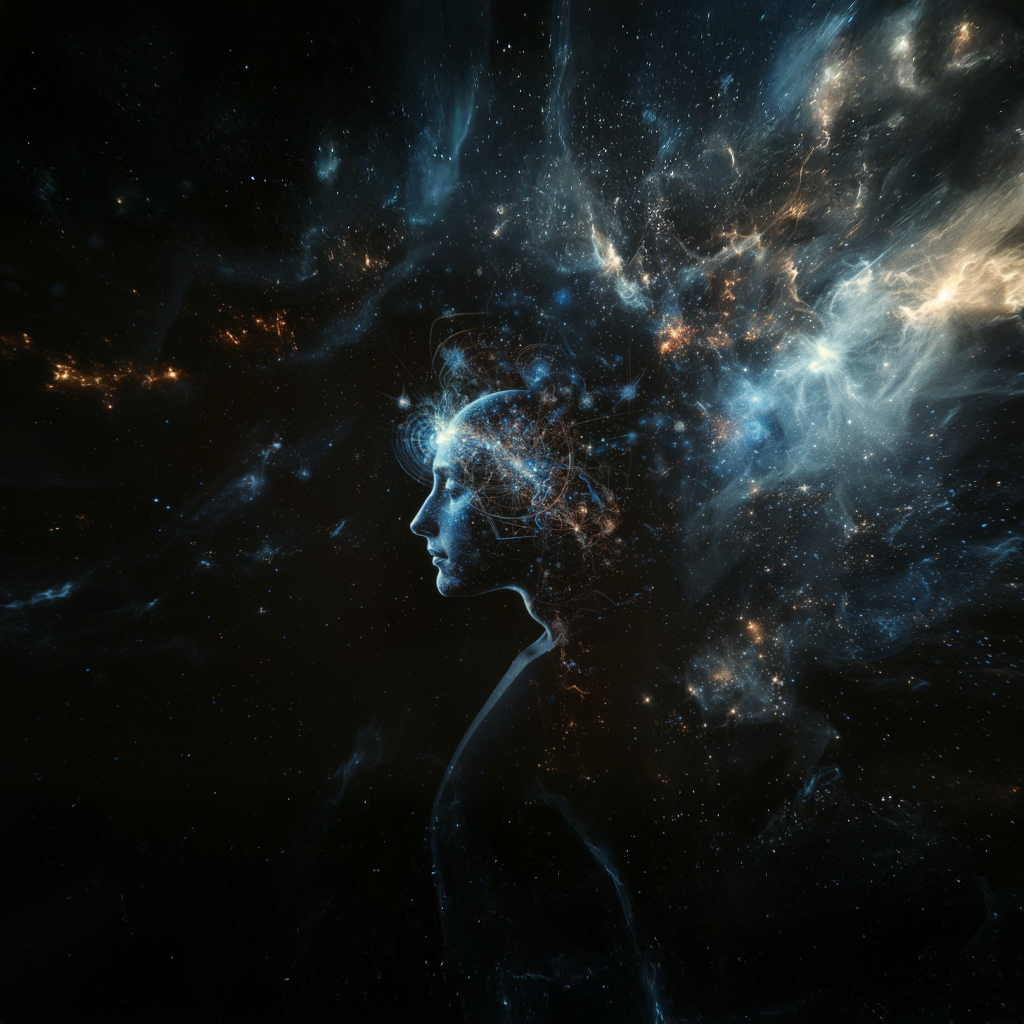
Between Ancient Wisdom and Modern Discoveries
Since the beginning, humanity has sought to understand what happens to consciousness when the body dies. Through the ages, this question has slipped into the temples of Egypt, the wisdom schools of India, the mysteries of Eleusis and into modern laboratories. It returns constantly, like an inner tide: does life continue beyond death, or does it fade into nothingness?
In ancient Egypt, priests taught that the Ka, vital breath emanating from the divine, survived the death of the body. The separation between the Ka and the Ba, an even more subtle spiritual essence, was only a passage, an initiation toward the light of Osiris. Death was perceived as a journey, a crossing toward eternity. Plato took up this idea in the Phaedo, affirming that the soul, immortal, takes on several bodies before returning to the purity of its origin. The Greek mysteries of Eleusis already evoked this periodic return of consciousness, like the cycle of Persephone rising each spring from the depths to bear witness to life's victory over death.
In India, the sacred texts go even further. In the Upanishads, the soul — Ātman — is described as eternal, indestructible, identical to the supreme Reality, Brahman. "The Ātman is not born, does not die," says the Katha Upanishad. "It has no origin, it is without end, it is never killed when the body is killed." The Bhagavad-Gita takes up this same breath: Krishna teaches Arjuna that the true soul is not reached by weapons, nor consumed by fire, nor dried by wind. It travels from one body to another like changing clothes. Thus, in the world's most ancient wisdom, the continuity of life is not a dogma: it is the very nature of Being.
Millennia later, this vision finds an unexpected echo in contemporary science. In 1975, American physician and philosopher Raymond Moody published Life After Life, where he collected the first accounts of near-death experiences: men and women who, having returned from cardiac arrest, recount a light of love, an ineffable peace, an encounter with a Presence. Neurosurgeon Eben Alexander, trained in the most rational medicine, testifies in turn in Proof of Heaven: plunged for several days into a coma, he experiences a reality of pure consciousness, forever transforming his vision of the world. Dutch cardiologist Pim van Lommel, in Consciousness Beyond Life, studies these phenomena in clinical settings and draws a disconcerting conclusion: consciousness seems to exist independently of measurable brain activity.
These researchers join, unknowingly, the voice of ancient sages: that of a consciousness that does not extinguish, but unfolds on other planes. Canadian psychiatrist Ian Stevenson devoted his life to studying the precise memories of children recounting past lives — compiled in his work Twenty Cases Suggestive of Reincarnation. Psychologist Michael Newton, through Journey of Souls, explored the intermediate states of consciousness between two incarnations, describing a world of light and learning. Philosopher and engineer Bernardo Kastrup, in The Idea of the World, proposes today a bold metaphysics: consciousness is not produced by the brain, it is consciousness that generates matter and phenomena. And physicist Philippe Guillemant, researcher at CNRS, advances the hypothesis that consciousness, interacting with time, can influence the future itself — as if our intentions already sculpted the path that opens before us.
Thus, from one end of history to the other, the threads come together. What the Egyptians sensed, what the sages of India taught, what Plato imagined and what science is beginning to measure, everything seems to tell the same story: life never stops, it only changes form. A recent study conducted in 2024 on more than eight hundred people who experienced an NDE reveals profound and lasting transformations: a radical peace in the face of death, an increased sense of love and compassion, an opening of consciousness. Even neuroscience, by observing the atypical electrical oscillations of the brain at the moment of death, seems to capture an ultimate trace of this inner light — a fleeting echo of the soul leaving its earthly envelope.
But true understanding does not come from numbers or machines. It is born in the silence of being. Each person can ask themselves: what do I feel at the idea that my consciousness could continue after death? If this were true, how would it transform my way of living, loving, forgiving? Have I already perceived, in a dream, an intuition, or a memory, the echo of a reality vaster than my body?
These questions do not demand an immediate answer; they are doors. For the mystery of life's continuity is not to be solved, but to be contemplated. It resides in this intimate certainty that there exists within us something unalterable — a core of light, a silent witness that the ancients called Ātman, that the Egyptians named Ka, that Christian mystics sensed under the name of immortal soul.
To discover this presence within oneself is already to sense eternity. Death is then no longer an end, but a passage. And consciousness, far from being a prisoner of the body, reveals itself to be the great traveler of the universe, the inextinguishable flame of the eternal Source.