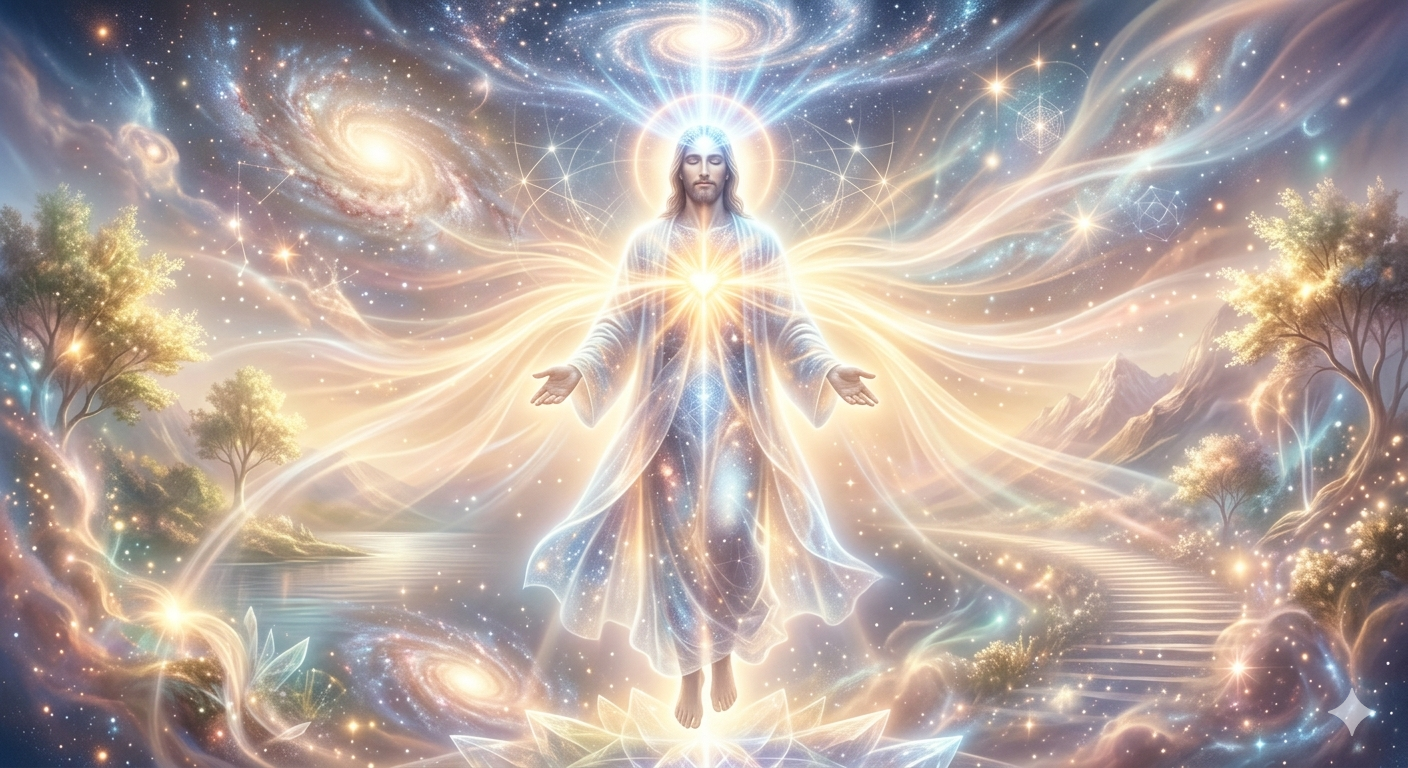
Christos: the inner and universal light
The word Christ was not born with Christianity. It comes from ancient Greek Christos (Χριστός), which literally means "anointed", "consecrated", "the one who received anointing". This term is itself the Greek translation of the Hebrew Mashiah(Messiah), meaning "anointed by God". Originally, it does not designate a unique person, but a state, a spiritual function or a level of inner realization.
Long before Jesus Christ, the idea of "Christos" existed in different forms in mystical and pagan traditions. In Egypt, Osiris and Horus embodied processes of inner death and rebirth. In Greece, the mysteries of Eleusis spoke of illumination and direct revelation. In solar cults, man could become a bearer of light. The common point of these traditions is an inner transformation leading to union with the divine, a direct experience of light and universal consciousness.
The Christos thus corresponds to a universal state of consciousness, a spiritual energy accessible to human beings, capable of merging the higher mind, the heart and the source. It represents the direct experience of the divine within oneself, an illumination lived and embodied, far from imposed beliefs or dogmas. Great mystics, like Ma Ananda Moyi, radiated this light in a tangible way, just like certain Christian saints and initiates in various traditions. The Christos is not an abstraction: it is lived, felt, present.
Inner awakening: the personal quest
In a world saturated with contradictory discourse, false landmarks and authority figures that multiply, it becomes essential to understand that the quest for Christ is not external. It is found neither in systems, nor in dogmas, nor in what we erect as absolute models. It is not found in maya, this veil of illusions that diverts the being from its own essence. Seeking outside what is inside only reinforces the chains of illusion.
Certain great consciousnesses have expressed this truth with simplicity. Ma Ananda Moyi, when asked about which master to follow, replied that the greatest of gurus is the inner guru. This statement overturns everything: it invites us to reclaim our sovereignty and to fully inhabit our spiritual quest. Jesus Christ himself would have declared: "You are gods." This phrase places the human being in immense responsibility: that of recognizing and actualizing within himself a potential divine nature.
But it is not enough to reject external dogmas to be free. True liberation involves deep inner work, an effort on the mind and on the heart. It involves purifying the mind, transcending conditioning and fears, developing goodness, benevolence, altruism and love without attachment, authentic compassion for all forms of life. The Christos manifests in the way of being in the world, in the capacity to see the other without projection and to act with righteousness. It is a state that unifies, pacifies and connects.
Towards responsibility and unity
This opening engages a new responsibility. There was a time when humanity could say: "they know not what they do", but today, consciousness pushes us to perceive that what is done to the other is done to oneself. Separation gradually fades to give way to a unified perception of life. "I am you, and you are me" is not a poetic idea, but a reality to integrate. With it comes a requirement: to become responsible for one's own evolution, no longer dependent on an external system, but engaged in a conscious process of transformation.
The source: origin and connection
The notion of source then becomes central. It is no longer about an external, separate God, but a living reality, omnipresent, a conscious origin from which everything emanates and to which everything can return. The true spiritual revolution would not be the appearance of a new religion in the traditional sense, but the emergence of a direct and individual connection to this eternal source.
A complementary dimension of this reality is what could be called the return of Christ. This is not about an external event or a historical return, but a progressive rise of Christic consciousness within humanity. This energy acts inwardly and collectively, silently awakening beings capable of receiving it. These beings, by connecting to this light, transform their way of thinking, feeling and acting, and influence in a subtle but profound way all of humanity.
A transformed humanity
We can then imagine a transformed humanity. Beings who no longer recognize themselves by their social masks, their constructed identities or their belongings, but by a quality of presence and inner transparency. Where there is no longer any shadow to hide, no false ego to defend, no role to play, human relationships change radically. They no longer rest on fear, manipulation or attachment, but on direct recognition: "I see you as an expression of the same source as me." This recognition naturally dissolves conflicts. It becomes incoherent to harm the other when one perceives that they are not separate from oneself.
The human being becomes a point of passage, a bridge between the visible and the invisible, between matter and consciousness, between the source and the world. But this bridge is not decreed: it is built through sincere work, a discipline of heart and mind, through self-observation, the transformation of reactions and the development of a higher intelligence capable of perceiving beyond illusions. When this level of consciousness activates and unites with the heart, a circulation of energy becomes possible, traversing the being and diffusing around. This transforms not only the individual, but also the material world and nature itself. The human being, as a conscious channel of light, influences the fabric of life. As consciousness expands, reality takes on a more harmonious and just form.
The Christos does not wait in a hypothetical future. It reveals itself as one becomes capable of making room for it. And perhaps the real question is not: "when will Christ return?" But rather: are we ready to let it emerge within us?